


New Village LLC builds retaining walls and masonry structures throughout Westminster, MD for both functional and aesthetic purposes. We work in concrete segmental block, natural stone, fieldstone and boulder, and brick — whatever the site, scope, and design require. Our crew understands both the structural side of retaining wall construction and the craft side of masonry work.
Carroll County’s terrain is hilly. Sloped properties are the norm, not the exception, and retaining walls are a practical necessity on most significant outdoor projects. We’ve built walls to create level pool areas, flat patio platforms, terraced garden spaces, and stabilized slopes across the Westminster region.
Materials We Work With
- Concrete segmental block (Allan Block, Versa-Lok, and similar) — engineered, versatile, available in many styles and colors, strong structural performance
- Natural fieldstone and boulder walls — heavy, durable, well-suited to rural and naturalistic settings
- Natural stone — flagstone, bluestone, and cut stone for a more refined finish
- Brick — traditional masonry for decorative walls, raised planters, and architectural features
- Timber — cost-effective option for lower walls in residential settings
Drainage — The Most Overlooked Factor
Retaining walls fail primarily because of water, not the wall material itself. Hydrostatic pressure from water-saturated soil is one of the most destructive forces a wall faces. We build drainage into every retaining wall we construct — gravel backfill, perforated pipe, or both depending on wall height and soil conditions. A wall without proper drainage is a wall that fails prematurely. We don’t build walls that way.
Masonry Work
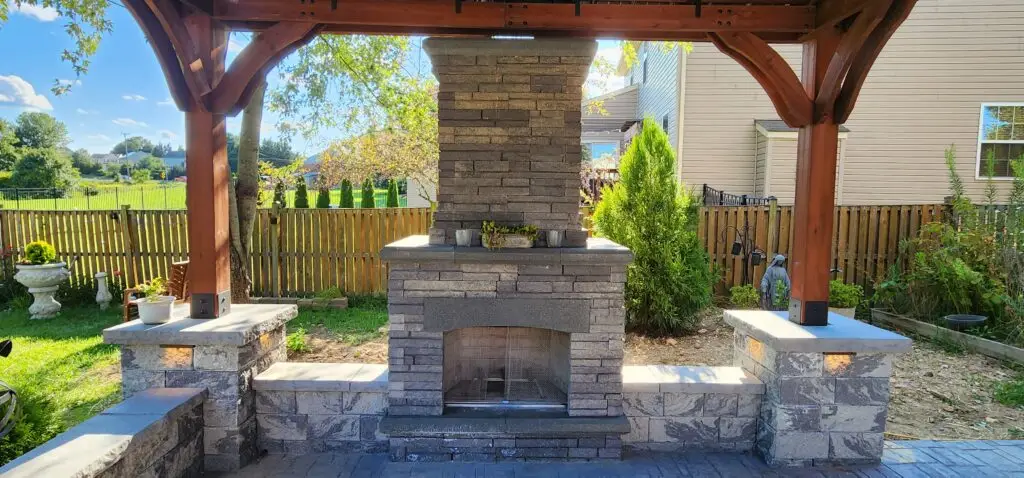
Beyond retaining walls, we perform general masonry work including outdoor fireplaces and fire pits, raised planters and landscape borders, decorative walls and pillars, mailbox and post bases, and brick or stone facing on outdoor structures. If it involves stacked stone, block, or brick in an outdoor setting, we do it.
Frequently Asked Questions
How tall can a retaining wall be without a permit in Maryland?
Generally, walls under four feet in Maryland do not require a permit, though rules vary by county and whether the wall is adjacent to a structure or waterway. Walls over four feet typically require engineering review. We’ll advise on your specific situation during the estimate.
What causes retaining walls to fail?
The most common cause is inadequate drainage behind the wall. Hydrostatic pressure from saturated soil pushes the wall forward over time. Improper footing depth and insufficient wall batter are also contributing factors. All of these are addressed in how we design and build.
Can you replace an existing failing retaining wall?
Yes. We demolish and replace failing walls regularly. We assess what caused the original to fail and build the replacement to avoid the same problem.
What’s the most popular retaining wall material?
Concrete segmental block is the most commonly used for functional retaining walls. It’s engineered for load-bearing, available in styles that look good, and doesn’t require the mortar work that masonry stone does. For naturalistic settings, fieldstone and boulder walls are popular. The right choice depends on the site and aesthetic goals.
Do you build outdoor fireplaces and fire pits?
Yes. Masonry fire pits and outdoor fireplace structures are part of our masonry work. These are usually built as part of a larger outdoor living project.
COMMONLY PAIRED WITH THIS SERVICE
- Grading — Retaining walls and grading almost always go hand in hand on sloped properties.
- Drainage Solutions — Drainage behind and around retaining walls is essential to their longevity.
- Patios & Stamped Concrete — Walls create the level area a patio is built on.
- In-Ground Pools — Pool installations on sloped lots regularly require retaining walls.
- Outdoor Living Spaces — Terraced outdoor spaces use retaining walls as defining architectural elements.