

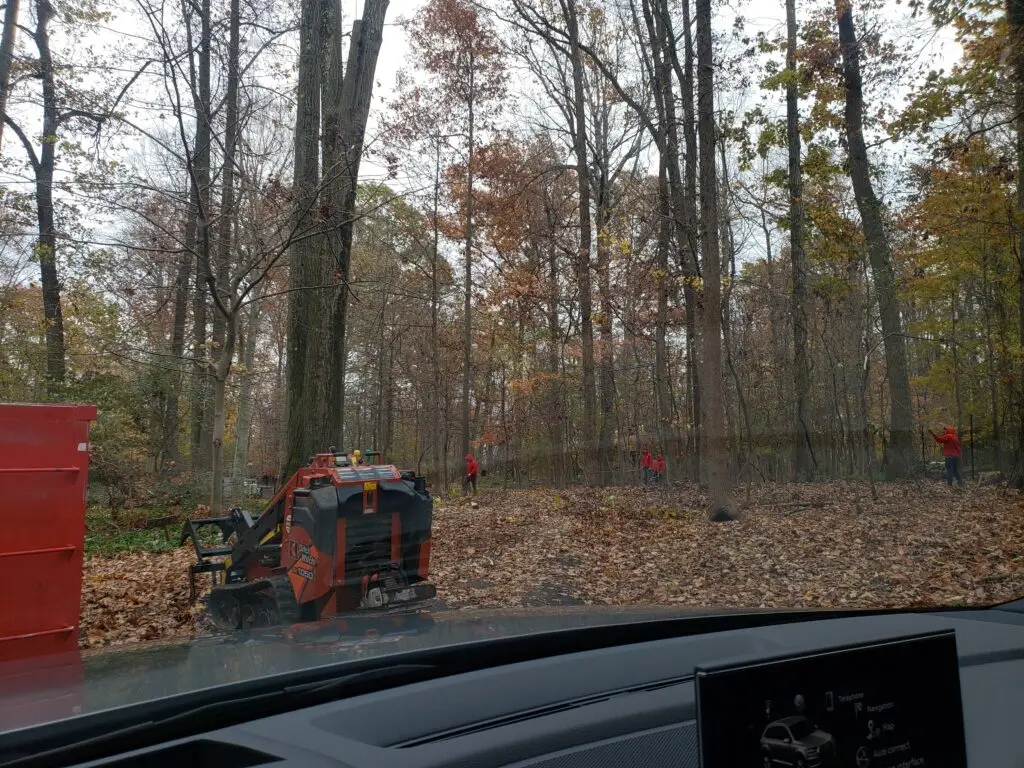
Forestry mulching is a land clearing method that uses a specialized tracked machine to grind trees, brush, stumps, and vegetation into fine mulch directly on site. Rather than cutting, hauling, and disposing of material separately, the mulcher processes everything in one pass and leaves behind a mulched layer that covers and protects the ground.
It’s efficient, less disruptive to surrounding soil and terrain than traditional clearing, and eliminates the need for debris piles and haul trucks on many sites. New Village LLC provides forestry mulching services throughout Westminster, MD and the region.
When Forestry Mulching Makes Sense
- You need to clear a site quickly and want to avoid hauling debris
- You want to preserve topsoil and minimize soil disturbance
- The site has dense brush, small to medium trees, or heavy overgrowth
- You’re managing rural acreage, hunting land, or recreational property
- The terrain is steep or irregular — mulching equipment handles slopes well
- Invasive species management or habitat clearing
Frequently Asked Questions
Is forestry mulching the same as land clearing?
They accomplish the same general goal — removing vegetation to open up land — but the method is different. Mulching processes everything in place. Traditional clearing cuts and hauls. Many people search for one when they mean the other, so just describe what you’re trying to accomplish and we’ll help figure out the right approach.
What size trees can a forestry mulcher handle?
Most forestry mulchers handle trees up to approximately six to eight inches in diameter effectively. Larger timber is typically felled conventionally first, then the mulcher processes the remainder. We’ll assess your site and tell you what the right combination of methods is.
What happens to the mulch left on the ground?
It stays as a ground cover layer and decomposes into the soil over time. If you want it worked in or removed, that can be discussed. For most properties, the mulch layer is a benefit — it suppresses weeds, retains moisture, and prevents erosion.
Is forestry mulching better than traditional clearing?
It depends on the project. For dense brush and moderate-sized trees where you want material processed quickly and in place, mulching is often faster and more cost-effective. For heavy timber or sites that need a very clean finish for construction, traditional clearing may be better. Many projects use both.
COMMONLY PAIRED WITH THIS SERVICE
- Land Clearing — Large or mixed sites often combine mulching with traditional clearing methods.
- Rough Grading — After mulching, grading shapes the site for its intended use.
- Excavation — Site development following mulching often requires excavation next.
- Drainage Solutions — Clearing land changes water flow. Drainage work often follows mulching.